
What does My Child’s Body Need in Nature?
Many parents notice that time outside does not affect their child in predictable ways. One child may settle and soften with movement, fresh air, and open space, while another becomes dysregulated, overwhelmed, or more reactive. These differences are not a reflection of parenting or effort. They are often a reflection of how a child’s nervous system processes sensory input, movement, and environmental demands.
Research across neuroscience, occupational therapy, and developmental psychology shows that regulation is deeply connected to the nervous system’s ability to interpret safety, stimulation, and connection. Outdoor environments offer rich sensory input, including movement, texture, sound, visual complexity, and temperature. For some children, this combination supports calm and organization. For others, it can feel like too much all at once. Understanding how your child’s body responds to these inputs can help transform outdoor time from stressful or confusing into supportive and grounding.
Nature-based experiences have been shown to support emotional regulation, attention, and stress reduction in children, particularly when environments and activities are well matched to a child’s sensory and nervous system needs (Kuo, 2015; Chawla, 2015). At the same time, research on sensory integration and polyvagal theory highlights that regulation is not about exposure alone. It is about how the nervous system experiences and interprets that exposure in the context of safety, relationship, and predictability (Ayres, 2005; Porges, 2011).
This free guide was created to help parents better understand those nervous system differences. It offers a clear, research-informed framework for observing how your child responds to time outside and for choosing outdoor experiences that support regulation, confidence, and connection. Rather than offering rigid rules or universal prescriptions, the guide encourages curiosity about your child’s unique body and nervous system so outdoor time can become more intentional and supportive.
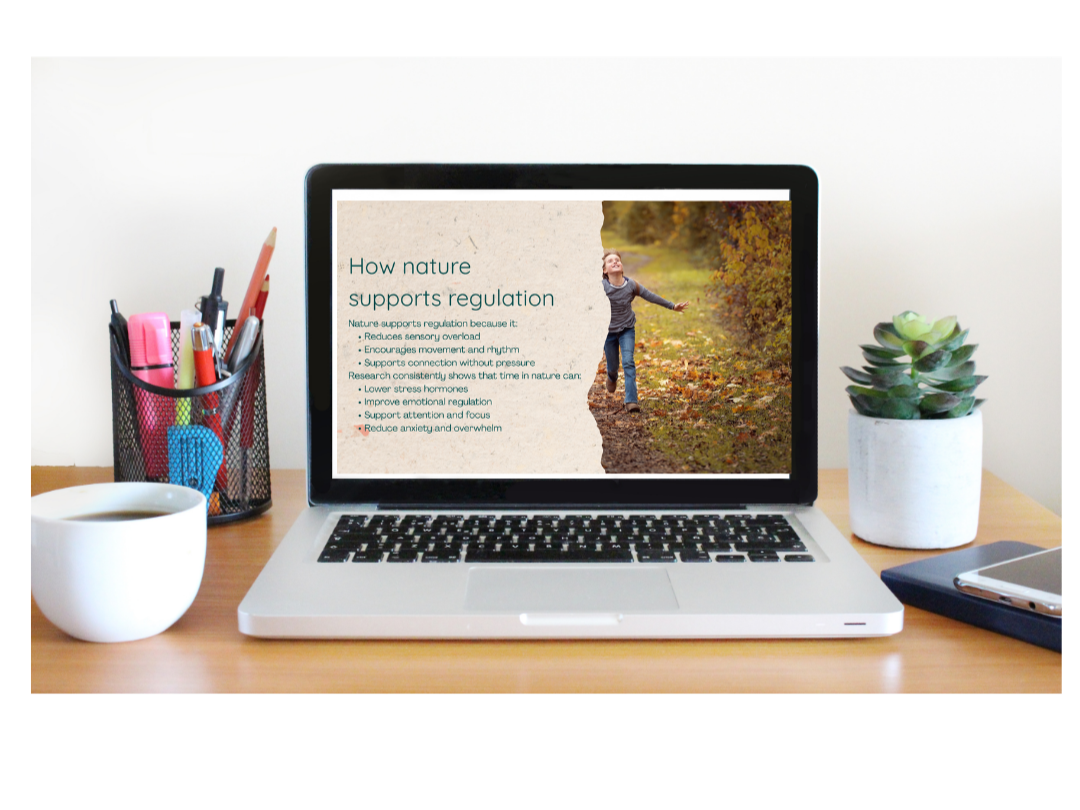
If you find yourself wondering why outdoor time feels regulating some days and hard on others, we have created a slide deck for parents that can help you slow down and make sense of what you are seeing. Check it out:
The Sensory Needs in Nature Guide for Parents
This walks you through the basics of nervous system responses in nature and offers a simple framework for noticing what supports your child best. The goal is not to get outdoor time “right,” but to help you feel more confident, curious, and grounded as you support your child’s body and nervous system.
evidence-informed guide to understanding how children’s nervous systems respond to nature so you can support regulation, curiosity, and connection outdoors.
You might be noticing…
Your child struggles to settle outside instead of relaxing.
Outdoor time sometimes feels dysregulating rather than calming.
You sense that fresh air alone is not enough to meet your child’s needs.
You are not alone. Every child’s nervous system experiences nature differently. What feels calming and organizing for one child may feel overwhelming or activating for another. This guide was created to help you make sense of those differences.
What this guide offers
When you download this free slide deck, you will receive:
A clear explanation of how children’s nervous systems respond to nature
Learn why outdoor experiences affect children in different ways and what regulation can look like in real life.
Research-informed insights, explained simply
Understand the connection between sensory input, movement, environment, and nervous system responses without clinical jargon.
Practical guidance you can use right away
Discover how to observe your child’s cues, adjust outdoor experiences, and choose environments that better support calm, confidence, and connection.
This guide is for you if you:
Care deeply about your child’s emotional and sensory needs
Want outdoor time to feel supportive rather than stressful
Appreciate trauma-informed, child-centered guidance
Value practical tools that fit into everyday family life
After reading this guide, you will be able to:
Recognize which outdoor experiences support your child’s regulation
Better understand your child’s responses to movement, sensory input, and space
Feel more confident planning outdoor time that supports your child’s body and nervous system
Ayres, A. J. (2005). Sensory integration and the child: Understanding hidden sensory challenges. Western Psychological Services.
Chawla, L. (2015). Benefits of nature contact for children. Journal of Planning Literature, 30(4), 433–452. https://doi.org/10.1177/0885412215595441
Kuo, M. (2015). How might contact with nature promote human health? Promising mechanisms and a possible central pathway. Frontiers in Psychology, 6, 1093. https://doi.org/10.3389/fpsyg.2015.01093
Porges, S. W. (2011). The polyvagal theory: Neurophysiological foundations of emotions, attachment, communication, and self-regulation. W. W. Norton & Company.